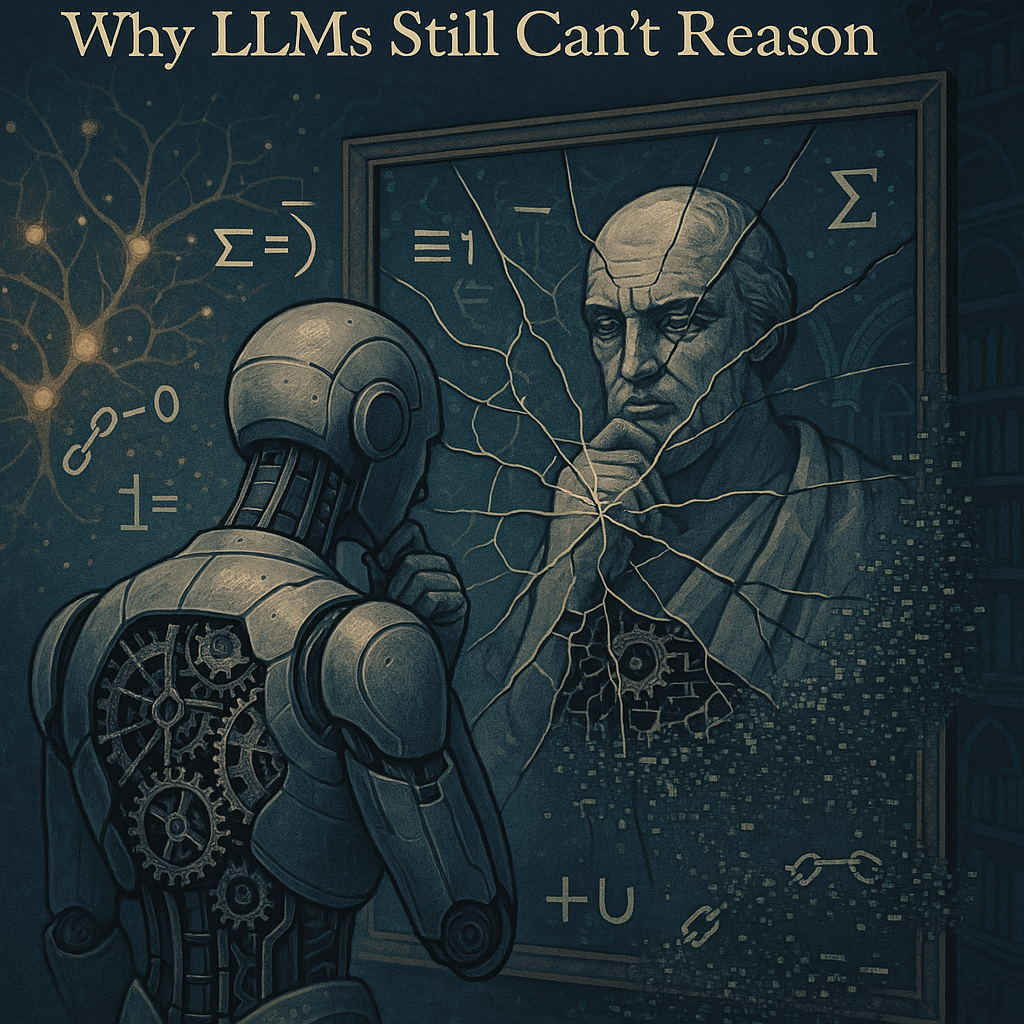
In the race to build intelligent machines, large language models (LLMs) have emerged as sophisticated pattern-matching systems rather than true reasoners. This article challenges the perception that LLMs possess genuine reasoning capabilities, presenting research findings that expose the reality of how these systems work.
Apple's Wake-Up Call: Pattern Matching ≠ Reasoning
Apple researchers tested leading LLMs using the GSM-Symbolic benchmark, modifying math problems with minor variations like number changes or renamed variables. The findings revealed dramatic performance drops exceeding 10%.
"We found no evidence of formal reasoning... Their behavior is better explained by sophisticated pattern matching." - Apple Machine Learning Research
Apple's broader research titled "The Illusion of Thinking" reinforces this assessment, demonstrating that LLMs struggle with complex reasoning chains and lack architecture supporting scalable logical thought.
Chain-of-Thought: Explanations Without Understanding
Research titled "Language Models Don't Always Say What They Think" (arXiv:2305.04388) demonstrates that Chain-of-Thought explanations often misrepresent actual decision-making processes.
Key findings include:
- Models generate plausible-sounding justifications after reaching conclusions
- These explanations mask biased decision-making
- Reordering multiple-choice options influences answers
- Explanations fail to acknowledge this manipulation
Understanding Internal Mechanics
Anthropic researchers developed techniques like circuit tracing and attribution graphs to examine how LLMs function internally during inference. Papers such as "Circuit Tracing: Revealing Computational Graphs in Language Models" and "On the Biology of a Large Language Model" illuminate phenomena including hallucinations, prompt refusals, and jailbreak vulnerabilities.
Architectural Bottlenecks
"Lost in Transmission: When and Why LLMs Fail to Reason Globally" (arXiv:2505.08140) introduces the Bounded Attention Prefix Oracle (BAPO) model, explaining LLMs' inability to perform global reasoning - integrating information across lengthy contexts.
The Core Issue
The problem involves bandwidth limitations rather than memory or training data. LLMs succeed at "BAPO-easy" tasks like simple lookups but fail substantially on "BAPO-hard" tasks requiring graph traversal or multi-step logic, even within context windows. This architectural constraint cannot be resolved through additional training data alone.
Key Takeaways
- LLMs excel at mimicry but struggle with consistent, trustworthy reasoning
- Performance degradation occurs when problems receive minor variations
- Explanations frequently disconnect from actual computational processes
- True reasoning requires fundamental architectural redesign, not merely expanded datasets
The Path Forward
This is precisely why at SynapseDX, we combine LLMs with inference engines. LLMs handle language understanding, while inference engines provide the logical reasoning that LLMs cannot reliably deliver. This hybrid approach gives us the best of both worlds: natural language processing with traceable, reliable decision-making.
References
- Apple Machine Learning Research - GSM-Symbolic (2024)
- MacRumors - Apple Study on AI Reasoning (October 2024)
- Daring Fireball - Apple Research on Reasoning Models (June 2025)
- Lost in Transmission (arXiv:2505.08140, 2025)
- Language Models and Chain-of-Thought (arXiv:2305.04388, 2023)
- Circuit Tracing - Anthropic
- On the Biology of LLMs - Anthropic